Mr. Poppins' Magical Classroom
Math and English with Puppets and Songs
Mr. Poppins arrives at castle school with fraction pies, sentence cards, and a puppet theater. His playful lessons stay carefully planned, helping students sing, practice, explain their thinking, and grow more confident.
The Arrival of Mr. Poppins
It was a bright morning at castle school when Mr. Poppins arrived with a top hat, a lesson book, and a canvas bag that jingled softly.
“Good morning,” he said. “I am Mr. Poppins. We will read, count, write, sing, and sometimes use puppets. We will also listen, take turns, and show our work.”
The students looked at the jingling bag.
“Are there bells in there?” asked Mina.
“One bell,” said Mr. Poppins. “And three fraction pies.”
Pie and Pizza Take the Stage
Mr. Poppins set a puppet theater on the front table.
“Today we meet Pie and Pizza,” he said.
He held up two round cardboard puppets divided into equal slices.
“If Pie has four equal slices and Mina gets one, what fraction does she have?”
“One fourth,” said Mina.
“How do you know?”
Mina pointed to the slice. “One out of four equal parts.”
Mr. Poppins wrote her explanation on the board. The puppet was funny, but the thinking was clear.
Singing through English lessons
The next lesson began with a quiet clap rhythm.
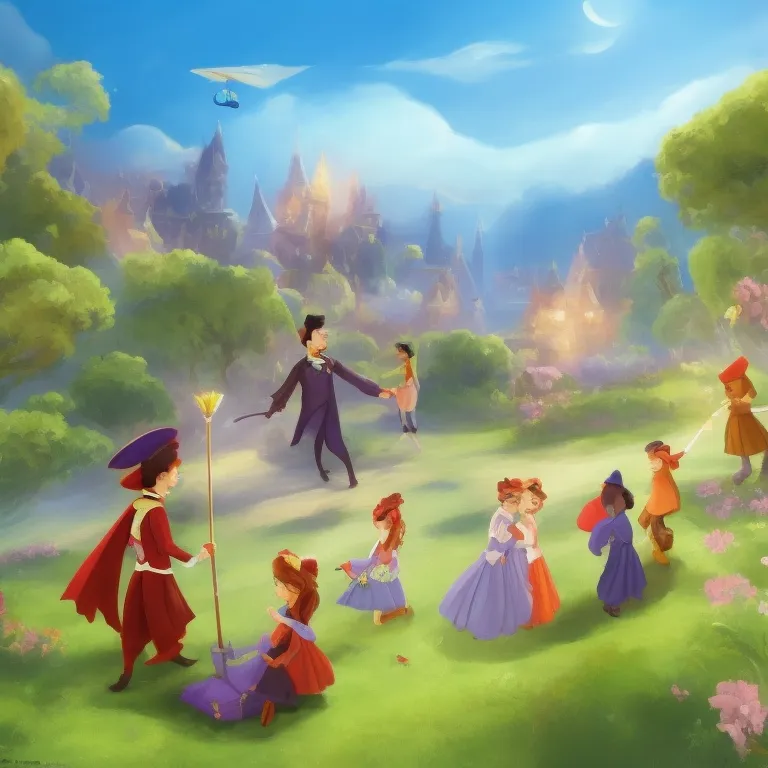
“Adjectives describe,” sang Mr. Poppins.
“Blue door, tall tower, sleepy cat,” sang the class.
“Verbs do the action.”
“Run, read, stir, sit.”
After each song ended, they discussed what the words meant. The rhythm helped the rules stay in their minds.
Then Mr. Poppins handed out sentence cards.
“Circle the adjective. Underline the verb.”
The room grew quiet except for pencils. Song first, practice next.
Mr. Poppins Becomes a Friend to the Students
Mr. Poppins made room for feelings as well as facts.
If a student felt unsure, he said, “Show me where your thinking stopped.”
If two students argued over a puppet, he said, “The puppet can wait. The people come first.”
One day at recess, a ball bounced too hard and startled a younger child. Mr. Poppins checked that everyone was safe, then gathered the players.
“What rule would make catch safer?” he asked.
“Softer throws near the little steps,” said Mina.
“More space,” said Tomas.
They changed the game before playing again.
The Skeptical Teachers
Some teachers wondered whether the classroom was too noisy.
“How do you know they are learning?” asked Miss Quill.
Mr. Poppins invited her to observe.
She saw the song. She saw the puppet. Then she saw the students explain fractions in their notebooks and correct their own sentences.
After class, Mr. Poppins showed her his lesson plan.
“The puppet opens the door,” he said. “The practice does the work.”
Miss Quill nodded slowly. “That is more organized than I expected.”
“Top hats can be organized,” said Mr. Poppins.
A Classroom Full of Wonder
By spring, other teachers borrowed pieces of Mr. Poppins’ approach.
Miss Quill used a rhythm for spelling. Master Reed used story cards for history. Mr. Poppins borrowed Miss Quill’s quiet reading bell.
The school did not become one big puppet show. It became a place where teachers shared what helped students learn.
During review week, Mina solved a fraction problem without the puppet.
“Pie is resting today,” Mr. Poppins said.
“I can still do it,” Mina said, and she did.
The Open Lesson
When the school year closed, the class held an open lesson for families.

The students sang one grammar verse, solved two fraction problems, and read their own short stories aloud.
Mr. Poppins placed Pie and Pizza on the windowsill to watch.
“You used to help us,” Tomas told the puppets.
“They still can,” said Mr. Poppins. “But now your own thinking is doing more of the talking.”
The top hat jingled as he bowed, and the class bowed back.